
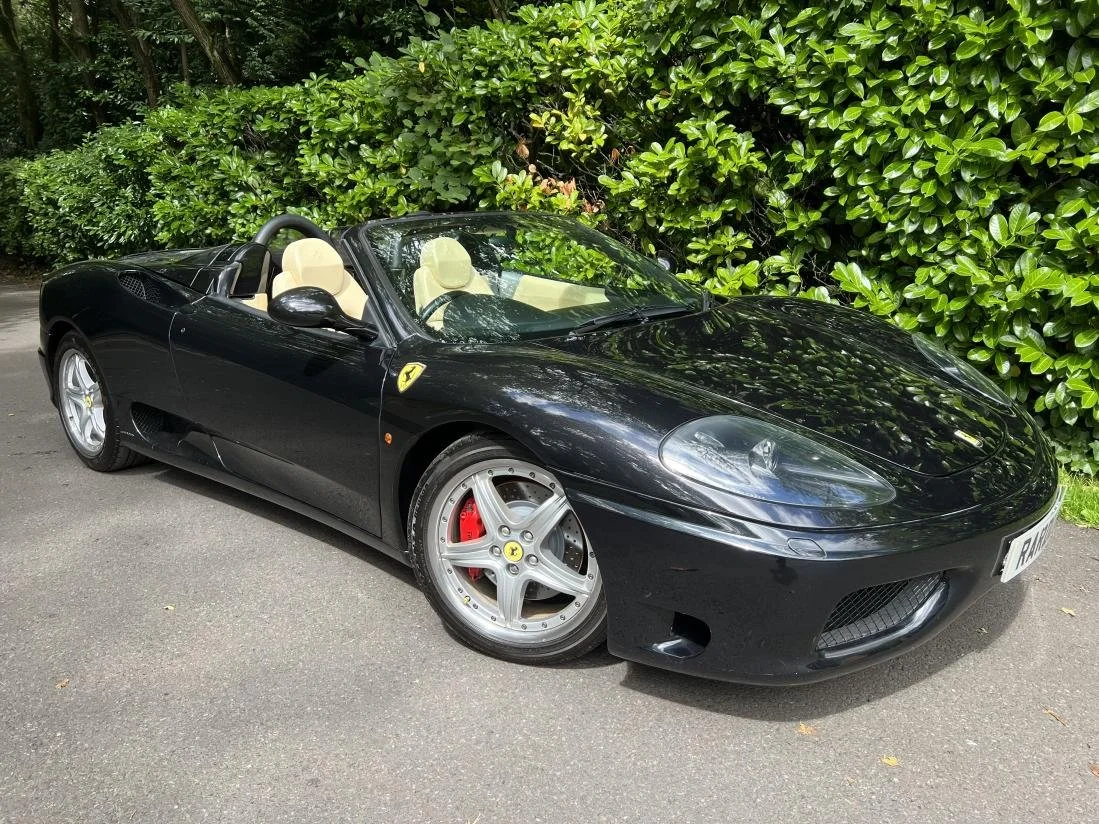
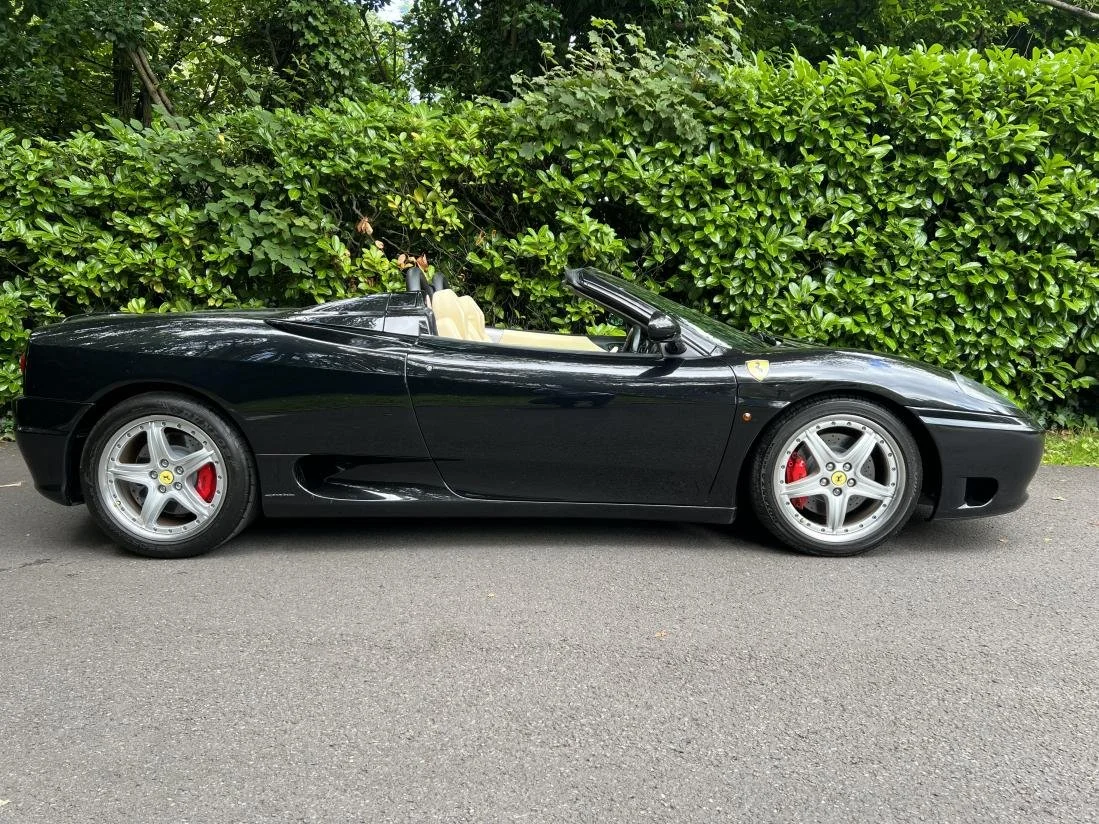
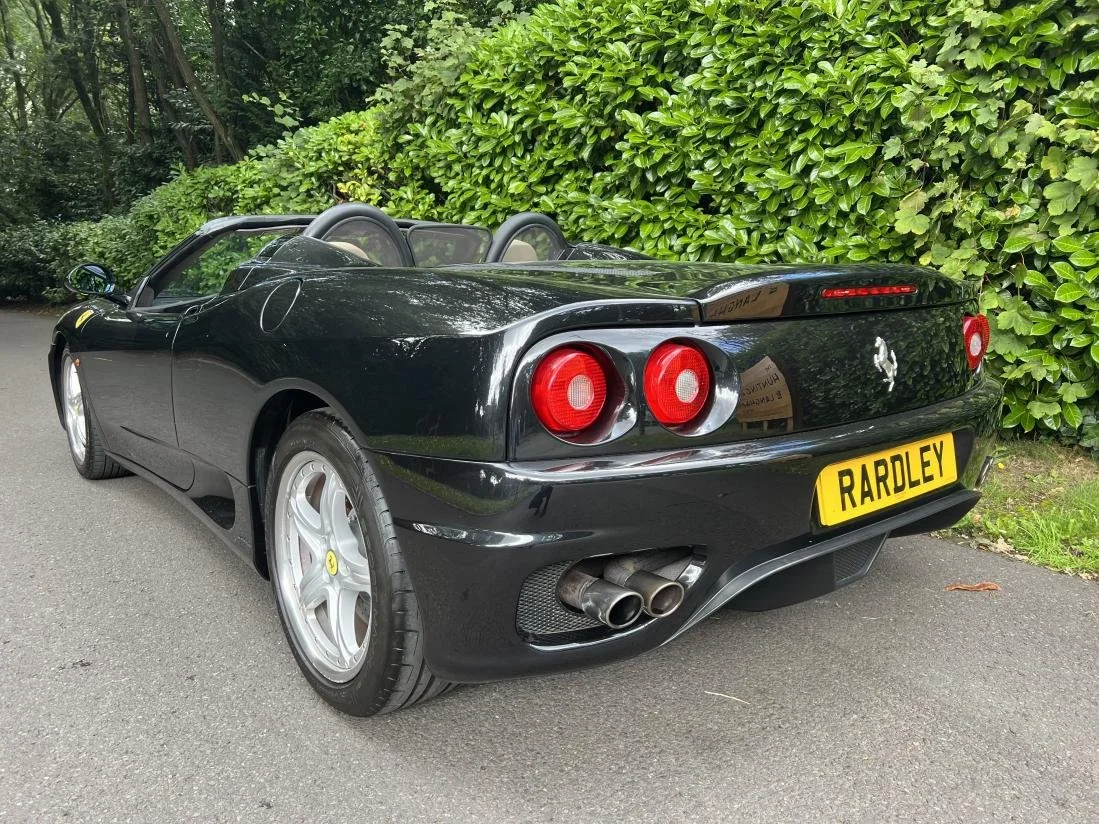
Ferrari 360 F1 spider One of 31.Just fully serviced
£59,990
YEAR: 2003
MILEAGE: 35,100 Miles
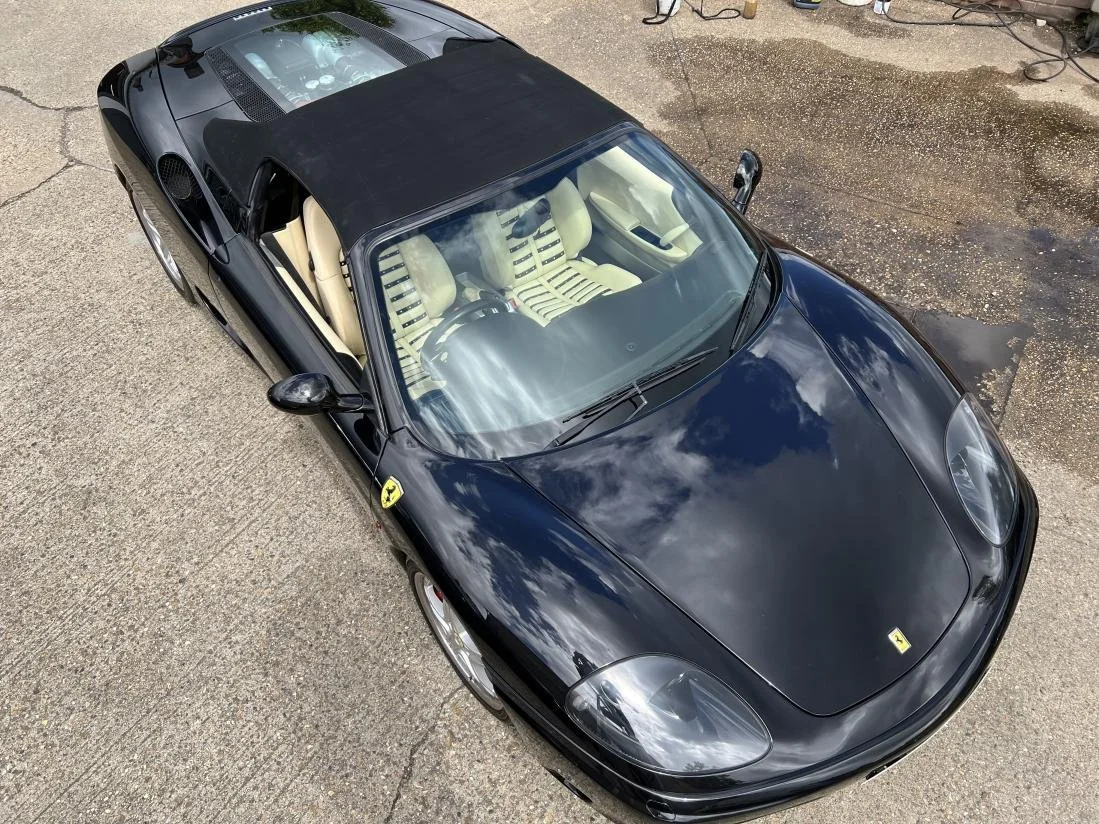
EXTERIOR COLOUR: Metallic black (Nuovo Nero Daytona)
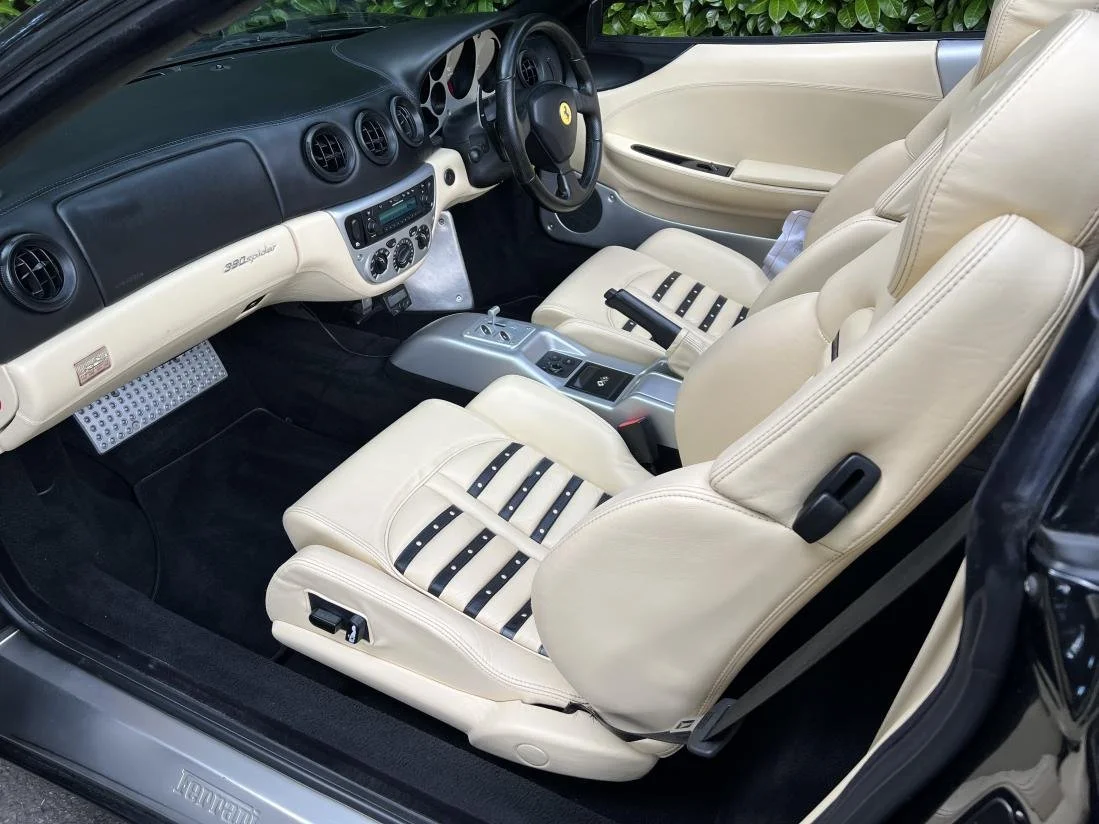
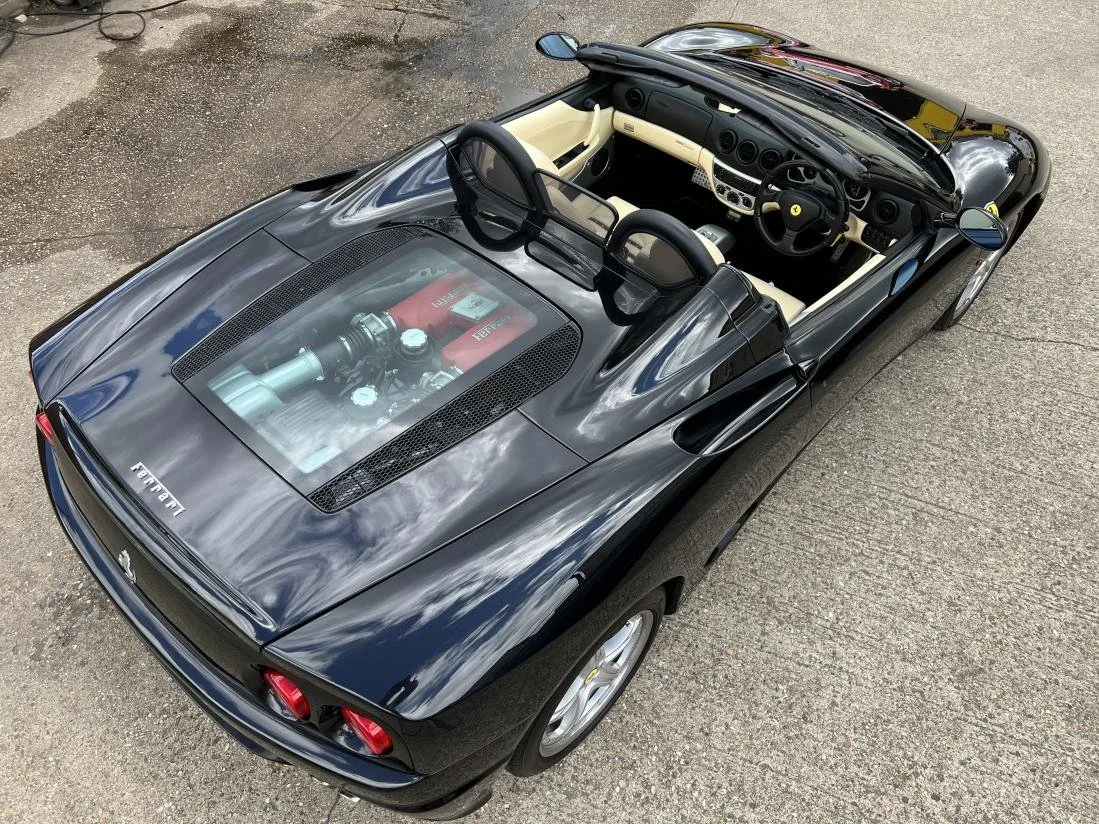
INTERIOR COLOUR: Cream hide with black dashboard and carpets
TRANSMISSION: F1 6 Speed Sequential
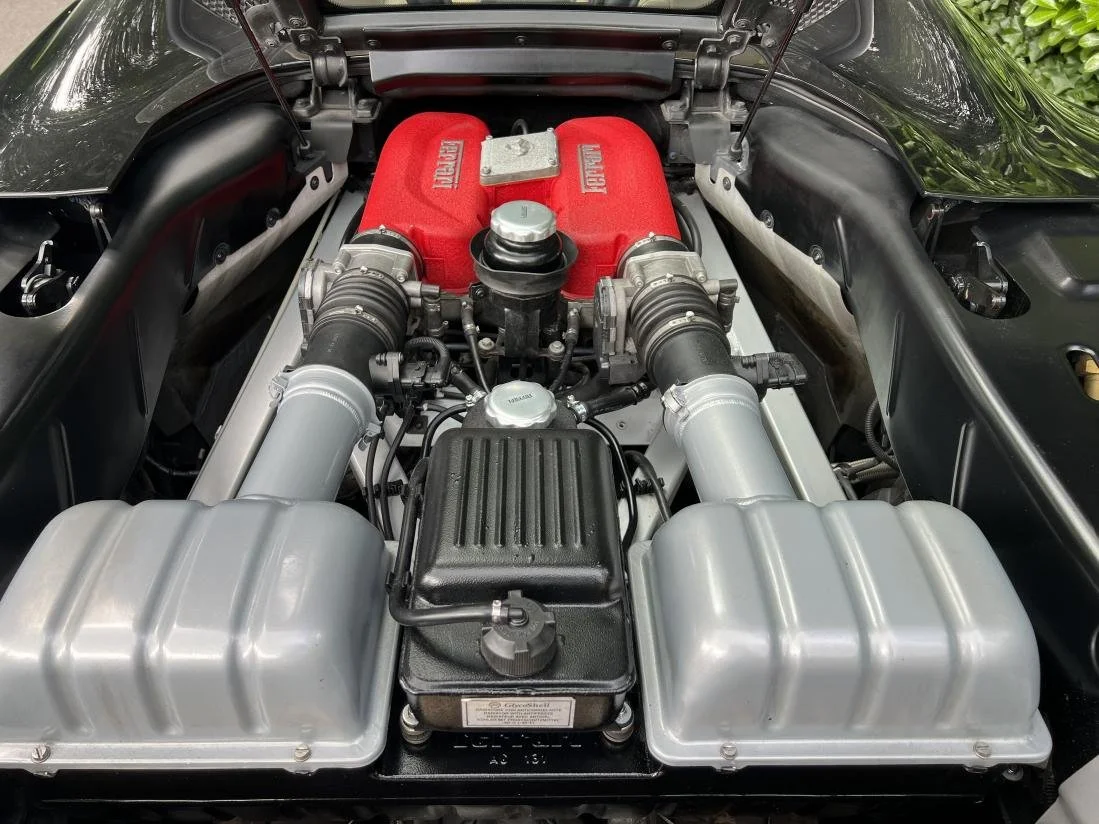
ENGINE: V8 3.4 litre Four valves per cylinder
TOP SPEED: 180 + mph
HORSEPOWER: 400 BHP @ 8,500 rpm
Entering production on 17 September 2003 and completed 12 days later on 29 September, the car was finished in metallic black (Nuovo Nero Daytona) with Crema 3997 hide and Nero 152 carpets. Upon completion, the car was transported to Ferrari UK in Surrey. It is one of 513 F1 Spiders, of which 280 remain taxed or SORN, with just 31 in metallic and non-metallic black.
The car was then sent to Maranello Sales Ltd on the Egham Bypass, where it was first registered as RX53 UUD on 28 October 2003 as a demonstrator. The list price at the time was £118,695.00, plus £2,245.00 delivery, along with the first registration fee and road fund licence.
The car was additionally optioned with red brake callipers (CALR) at £444.00, a 6-CD changer (CDCH) at £720.00, prewiring and a kit for a battery charger (CHUK) at £516.00, black “Daytona” style seat inserts (DAY 1/STP 1) at £1,272.00, front “Challenge” style grilles (GRD2) at £324.00, enamel Scuderia wing shields (LOGO) at £684.00,electrically operated seats (ELEC)£1,526.00 and modular wheel rims (RIM 1) at £1,596.00.
Two days later, on 30 October 2003, it was sold to its first private owner in Surrey. Three months and 12 days later, on 9 February 2004, the car passed to its next owner, a company director from Cheshire, who applied the registration number 123T on 17 June 2004.
The registration number 123T was removed and replaced on 25 November 2005 with TEZ 171 when the car was purchased, with approximately 6,000 miles, from specialists Hillmoren of Leicestershire.
TEZ 171 was later removed and replaced by FN53 NDJ on 8 December 2015. This appears to have caused some confusion with the DVLA, who noted on the new V5 registration document that the car had previously been registered overseas before being registered in the UK, and that the 2005 owner was the first UK owner.
The car was later purchased by a company director from Northamptonshire on 18 March 2016 from Approved Used Vehicles Ltd of Coventry, with 25,996 miles.
The most recent owner acquired the car from the same dealer on 21 October 2017 with 30,247 miles. The current registration number, FF53 FER, was applied on 9 January 2021.
At the International Geneva Motor Show held in March 1999 Ferrari introduced its newest model, the 360 Modena. With V8 engined Ferraris accounting for almost two-thirds of total Ferrari production each year, the appearance of an all-new model in this configuration is extremely important to the Modenese firm.
While it continues the lineage of the 308, 328, 348 and F355, the new 360 Modena is all new, a car that Ferrari states was “planned for the new millennium”. Their objectives were to design a car with superior performance across the board, with innovative technical and aerodynamic features; provide new standards of space, comfort and ease of access; significantly reduce the car’s weight; and maintain the character and personality of a true sporting mid-engined Ferrari.
To achieve these goals for the 360 Modena meant that the project team, managed by Maurizio Manfredini, had to design the whole car from scratch, adopting new materials and construction methods. The single most important element of this redesign, a first for a Ferrari road car, was the extensive use of aluminium, not just for the body shell, but also for the chassis and other components.
Fortunately the specialists at Ferrari could call on years of research and experimentation with the use of aluminium dating back to the Formula One cars of the early 1970s. The main benefit of the all-aluminium chassis and bodyshell is a reduction on the car’s dry weight of 100kg (220lbs) compared to the F355 - despite the fact that the 360 Modena is actually larger plus a significant improvement in structural rigidity.
Styling
The styling of the new car is by Pininfarina, who have been designing cars for Ferrari since 1952. The 360 Modena brings the total number of Ferrari models designed by Pininfarina to 163. In the modern era the styling of a Ferrari has to be closely linked to the aerodynamic and performance requirements of the model. This is evident on the 360 Modena, with its two separate front air intakes, the vents ahead of the front wheel wells, and the air ducts to the rear of the car. A total of 5400 hours were spent in researching the shape in the wind tunnel. Other aerodynamic features include the flat underbody; the cut out in the front bumper that channels air beneath the car; the twin rear extractors; and the sloping rear windscreen. The result was a Cd of 0.335 and, more importantly, a negative Cz figure that gives progressively greater negative lift forces as speed increases. This force is evenly distributed between the two axles and maintains excellent balance even during variations in trim caused by acceleration or braking. All of this was accomplished without the use of winds or other external aerodynamic devices, allowing Pininfarina to keep good clean bodylines.
While Ferrari and Pininfarina are careful to invoke the images of past Ferraris in reference to the styling – the separate front air intakes made necessary by repositioning the radiators are likened to the Formula One and sports/racing cars of the early sixties; the air intakes on the rear fenders are said to recall the 250 LM; and the fast-back rear window has a long tradition on Ferrari berlinettas – all elements are also claimed to be highly functional. It is the frontal styling that has caused the most negative comments. The front fenders, which Pininfarina described as “muscular”, and the absence of the traditional central Ferrari oval grille (which at times in the past had to be “faked”) has left some observers unimpressed. It appears that Ferrari and/or Pininfarina heard such comments. Before the Geneva show ended a black license plate was added to the front of the 360 Modena’s on display, altering the appearance of the nose by adding that missing central element.
Engine
The engine powering the 360 Modena is a 90-degree V8, which has been completely redesigned to incorporate numerous innovations. Centrally mounted in-line behind the cockpit, in unit with the gearbox and differential, it has a total capacity of 3586cc, a bore of 85mm and a stroke of 79mm, and a compression ratio of 11:1. Delivering 400bhp at 8,500rpm, it produces 112bhp per litre making it the most powerful normally aspirated V8 ever built by Ferrari. It delivers a very generous peak torque figure of 38kgm at just 4,750rpm, and the torque curves even all the way up to 8,000rpm.
Combustion chamber design is new and incorporates bigger intake (three) and exhaust (two) valves, driven by four camshafts (two per bank) with hydraulic tappets. Lubrication is of the dry sump type. The main castings are in light alloy with wet steel cylinders liners, titanium connecting rods and forged aluminium pistons. Over-all weight of the motor is 184kg (495lb).
There is a particularly innovative inlet system feeding fuel separately to each cylinder bank. The Motronic ME7.3 dual engine management system, with two control units and two throttle valves that communicate through a Controlled Area Network (CAN) is the first dual system of its kind from Bosch.
The control units, small in size, take advantage of new micro-hybrid technology and are designed to function at high temperatures so they can be located near the engine. Using the position of the accelerator pedal and taking into consideration the vehicle speed, the ASR system and the F1 gearbox, the control units determine the actual throttle opening, the geometry of the variable inlet manifold, the exhaust timing and the engine control parameters.
The refined variable intake geometry intake manifold is a direct result of Formula One experience, and is clearly visible through the large rear windscreen, adding to the visual appeal of the automobile. There are two manifolds above the engine, which are connected to the underlying row of cylinders through short vertical ducts and the opposite bank of cylinders through longer ducts. Intake geometry is adjusted by two rows of throttle valves activated by the engine management control units. Air to the manifolds is supplied by the air intake in the left rear fender, which was designed to feed air in under pressure and thus produce a slight increase in power output – an extra 10 bhp at top speed. Engine noise is controlled by an acoustic baffle on the manifold. The exhaust system features variable backpressure with two valves on the silencer outlets. At low engine speeds the valves are closed, enhancing torque delivery while reducing noise to meet drive by noise emissions standards. At high engine speeds the valves open giving greater power and also increasing noise.
Gearbox
The longitudinal six-speed gearbox housing incorporates the engine oil tank in its single-piece casting, and the rear section serves to absorb impact energy. It was designed to work with either a manual gear change or with the electro-hydraulic actuated F1 system, which has been highly modified and improved on the 360 Modena. There are triple cone synchronisers on the first two gears and double cone on the others. The single dry plate clutch has coaxial hydraulic drive, and the limited slip differential has different locking percentages for acceleration and lift off.
Actuation of the F1 gearbox is by means of levers behind the steering wheel, just like on the Formula One car. When the Sport Mode is activated, the time for each single gear change is only 150 milliseconds. There are two other modes-Automatic, which requires the drive to only accelerate and brake while gear selection is automatic, and Low Grip, in which the car starts in second gear and all upshifts occur at lower engine speeds.
Taking advantage of the drive-by-wire engine management system, the 360 Modena F1 gearbox governs the accelerator completely during gear changes. While going down a gear it automatically “blips” the throttle, when changing up the system matches the best engine speed as the clutch closes. Thus both shifts are smoother and gear changes easier. With the gearbox, engine and traction control integrated the 360 Modena is significantly safer and more controllable.
Chassis
The 360 Modena features a classic Ferrari space frame chassis design. However, the structural frame members are made of extruded aluminium connected by castings where the members join. These castings allow for expansion during assembly, and also provide extra strengthening in areas subject to the greater stress. This process introduces a large number of new manufacturing and assembly technologies, which were designed specifically with the American Alcoa Company.
The specific weight of aluminium is one-third that of steel, and the weight of the overall chassis was cut by 28% despite a 10% increase in volume when compared to the F355.
Wheelbase and front track, respectively 150mm (5.9inches) longer and 155m (6.1 inches) wider than on the F355, increase cabin space, while improving stability and tyre wear. A double wishbone layout for the suspension was adopted front and rear with full kinematic properties and with anti-dive and anti-squat geometry. The upper and lower wishbones are in aluminium.
An innovative damping system was developed with Sachs. The four aluminium dampers each incorporate a solenoid, three sensors and a control unit, which also picks up car speed and braking signals from onboard sensors. A dashboard switch allows two driving programs, Sport and Normal. Using all the sensor’s input makes it possible to “brake” body movement immediately, maintain the best wheel-to-road contact, increasing grip and stability.
The steering is equipped with a non-speed-sensitive servo. The turning circle is just 10.8m (35ft 5 in) compared with 12 meters (39ft 5in) on the F355. The front tyres are smaller while the rear tyres are larger, offering advantages in handling, grip, aquaplaning and uniform wear. The alloy wheels weigh about 1kg (2.2lbs) less than the mag wheels on the F355.
Interior
Particular attention was paid to the quality of life on board the 360 Modena, starting with improved access made possible by increasing the size of the door cutout. The interior dimensions have been improved in all dimensions – length, height and width – as compared to the F355, thanks to the increased size of the car boot and redesigning the interior. In addition to the increased luggage space up front, due to the repositioning of the cooling radiators, there is also a bench behind the seats large enough for a pair of suitcases or a golf bag.
The increased use of aluminium is in evidence throughout the passenger compartment in numerous functional elements, which become styling elements as well: the tunnel, the pockets in the door panels, the driver’s pedals and the passenger’s footrest. The upholstery is available in 12 different colours to compliment the 15 exterior colours currently available and the customer can even choose the colour of stitching.
The cockpit is functional, offering the driver all the information he needs without distracting him - the layout of the dashboard puts all the main car control instruments in front of the driver with the large tachometer in the centre. The steering wheel can be adjusted for height and reach. Dual airbags are fitted. The seats have four-way manual adjustment or six-way electric adjustment on request.
Taken from the “Ferrari Market Letter” 20th March 1999.
Spider
Introduced at the 2000 Geneva motor show, the convertible or Spider version of the 360 was engineered to the highest standards to eliminate looseness or scuttle shake. The Spider gained only 60kg in strengthening and electric hood operation. This equated to.1 of second added to acceleration times and little or no difference to the maximum speed.